
My 4th butterflying trip to Western Australia
Most of this post describes my trip to WA in October / November, but before getting to that I’ll briefly cover my butterflying exploits since I returned from my April trip to Cairns and Cooktown.
Royal Botanic Gardens, Sydney
On 1st June I went to the Gardens in the hope of getting an open-wing shot of a male Bright Cornelian (Deudorix diovis). I did see one, but he was sitting with his wings closed about 10 feet above my head, so I got another underside shot instead.
There were a fair number of Southern Pearl-whites (Elodina angulipennis) on the wing, but not a lot else, though I got some photos of Common Crows (Euploea corinna) and Short-tailed Line-blues (Prosotas felderi). Not too bad for the first day of winter.
I tried again on 19th July; this time I found a very cooperative female Dark Pencil-blue (Eirmocides consimilis), which was a big surprise as whilst I’ve often seen the closely-related Common Pencil-blue (E. absimilis) in the Gardens this my first sighting of consimilis there. She paid no attention to me or my camera, so I took around a hundred shots as she fed from flowers and basked in the winter sunshine.
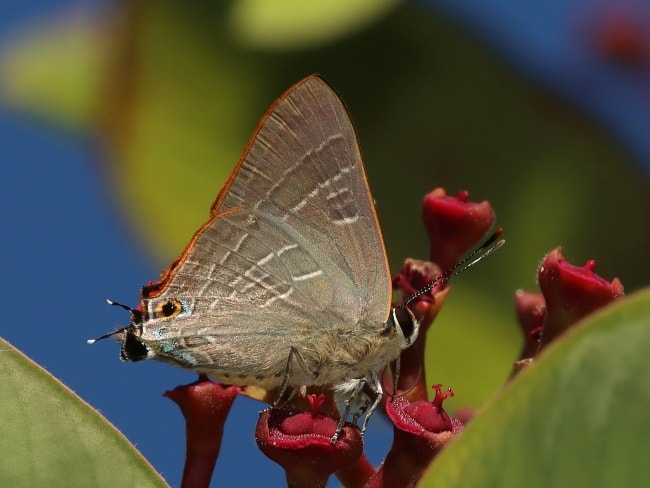
01/06/2025
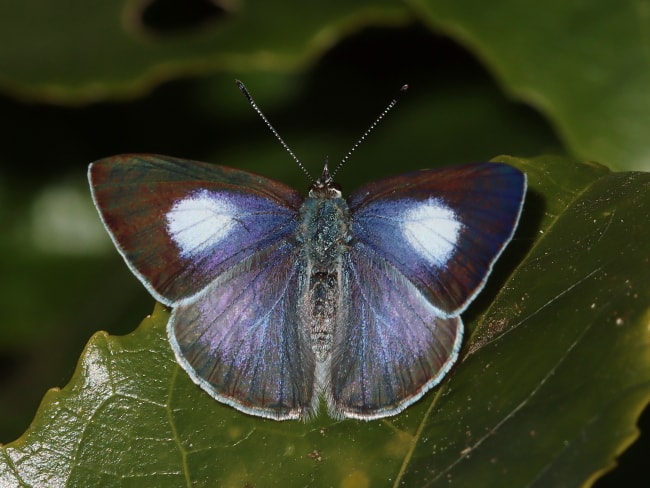
19/07/2025
At the end of August I went to Knapsack Park looking for more consimilis, as in the past it’s been a good place to see them feeding on Lantana flowers. Unfortunately most of the lantana has been removed, but I did find one male consimilis. He was rather small compared to others I’ve seen, but he was defending his little territory against any other insect that dared come near. Whilst he wasn’t as obliging as the female he did allow me to get a number of photos, so during the course of the winter I was able to get decent shots of both male and female consimilis, uppersides and undersides.
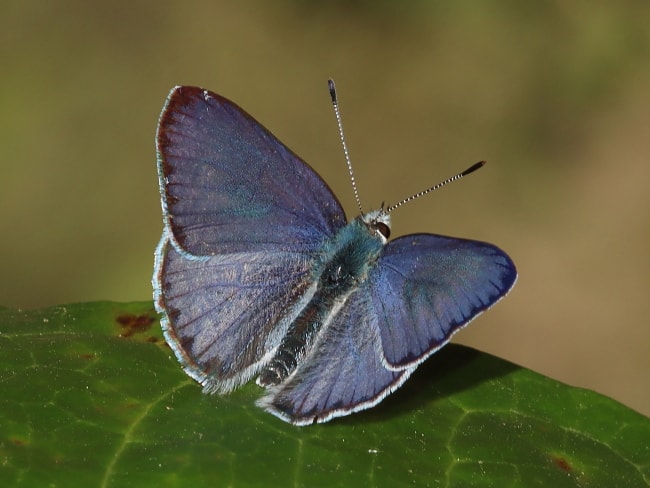
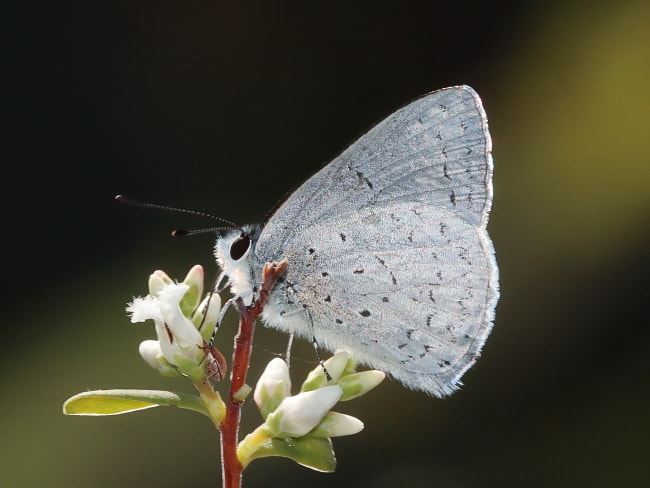
On 13th September I went to Duffys Forest for Silver-studded Ochres (Trapezites iacchoides). The bush was full of flowers; I don’t recall ever seeing so many, but unfortunately butterflies were few and far between. It had been a beautiful sunny morning all the way, but as happens far too often it became mostly overcast almost immediately after I reached the hilltop. I only saw one iacchoides and very few other butterflies.
Two weeks later I was at Lithgow for the Purple Coppers (Paralucia spinifera). It’s always great to see these little butterflies, but after an hour or so it became very windy and they mostly disappeared.
On the next two weekends I went out to the Blue Mountains but I didn’t see much at all, other than one very fine male Copper Pencil-blue (Cyprotides cyprotus).
I finally had a successful day on 5th October at Kurnell, where I was hoping to find Dull Heath-blues (Neolucia mathewi). Most of my shots of this species were taken at Kurnell on my first two visits to the site in 2005 and 2008. I saw plenty of mathewi on those occasions, but hardly any when I returned in 2020. On this fourth visit I walked quite a long way without seeing anything, but eventually I found a couple of very healthy colonies, with dozens of mathewi on the wing.
Western Australia
I had previously made 3 butterflying trips to Western Australia. The first was in 2008, and it was very successful because that happened to be a very good year for butterflies around the Perth area. On my subsequent visits in 2016 and 2017 I mostly went butterflying with my mate Derek, who lives in Perth and also photographs butterflies as a hobby.
This 4th trip was conceived back in April, when the two of us were in north Queensland with our collector friend Ross. Having had some success around Cooktown and Cairns we decided to do it all again in WA in the Spring.
Saturday 25th October : Perth
For our first day we were accompanied by Tobias, another Perth-based butterfly photographer. It was overcast with some showers, though the forecast was for things to improve as the day went on, so we headed out to Lesmurdie in the Perth hills to look for Western Sand-skippers (Antipodia dactyliota).
We did find a spot where some dactyliota were flying, but unfortunately they were only flying during the very brief intervals of sunshine. As soon as the sun disappeared the skippers did likewise, and unfortunately this usually meant quite a long wait for the next opportunity. Some time after midday we decided to move on; Derek and Tobias had both managed one or two photos, but I still hadn’t managed to get my first dactyliota shot since 2008.
We decided to go to Koondoola next. This had been the most productive site on my 2008 visit, with a number of interesting species being present in decent numbers, particularly Western Jewels (Hypochrysops halyaetus) which had been abundant. On the way we had a look at a site in Swan View which we’d been told had been a good spot for Varied Hairstreaks (Jalmenus inous), but when we got there we didn’t see any of them, or any of their Wattle foodplants. For that matter there were no Swans and no View to write home about either. We didn’t stay there long.
Before entering the bushland reserve at Koondoola we took precautions against ticks, as the place is notorious for them. In 2008 I found about 20 horrible Kangaroo ticks on my legs after a day spent there, so now I always cover myself with enough Aerogard to choke a small horse.
The weather was definitely improving, but Koondoola was extremely quiet with hardly any butterflies at all on the wing. There was just the occasional skipper, with Derek and Tobias getting shots of a Blue Iris-skipper (Mesodina cyanophracta), though I didn’t see any of those. I finally took my first photos of the day around 3:30pm, after Tobias spotted a female Sciron Ochre (Trapezites sciron) close to the path.
It had been a very slow start to the trip. When I went for a shower I found a medium-sized tick happily embedded in my thigh. I think Derek also picked up one that day, and Ross definitely did. Spoiler alert: it would not be the last.
Sunday 26th October : to Southern Cross
We left Perth early with a big day planned, as we were looking for Arid Bronze Azures (Ogyris petrina) and Laterite Ochres (Trapezites waterhousei), in what we hoped would be a repeat of a very successful day Derek and I spent back in 2016.
It had been rather overcast, but the further East we went the brighter it became, so we were hopeful of seeing some butterflies. Somewhere near Mukinbudin we were heading along a dirt road towards the petrina site when Ross pulled over because several of them were dogfighting in the road just in front of the car. We piled out and were treated to the spectacle of lots of male petrina, all vigorously contesting ownership of the road.
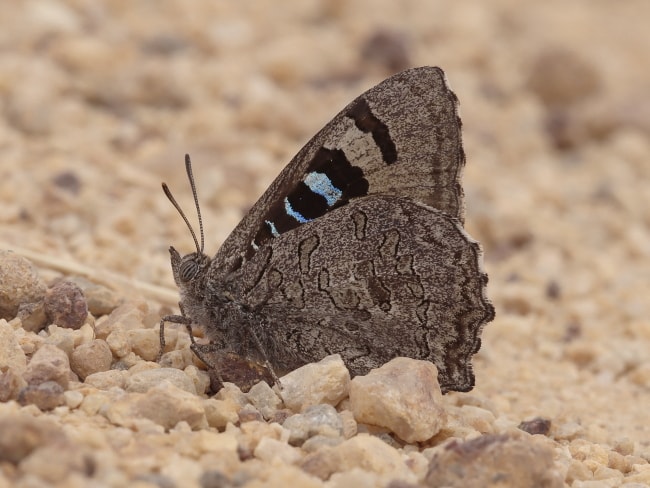
This is a butterfly species which is currently listed as Critically Endangered, known only from a small number of colonies, so it was brilliant to see so many of them; clearly this colony was doing very well. In fact the fact the sheer number of them made it difficult to get photos because although they frequently settled on the road they didn’t stay for long before taking off to do battle with a rival. It was rather frustrating, but eventually we found one male who was happy to remain settled for much longer, seemingly oblivious to other petrina and also to Derek and I getting close enough to take photos.
I think perhaps this specimen was newly-emerged and his wings were not yet hard enough for dogfighting. I spent a long time photographing him as he allowed me to take shots from both sides, and even when he did take off he soon settled again. I decided to name him Dennis. For a while I was lying on my stomach photographing Dennis from one side, while Derek was doing the same from the other side. Ross found this sight very funny and was having a good laugh at us; unfortunately he didn’t take a photo of us.
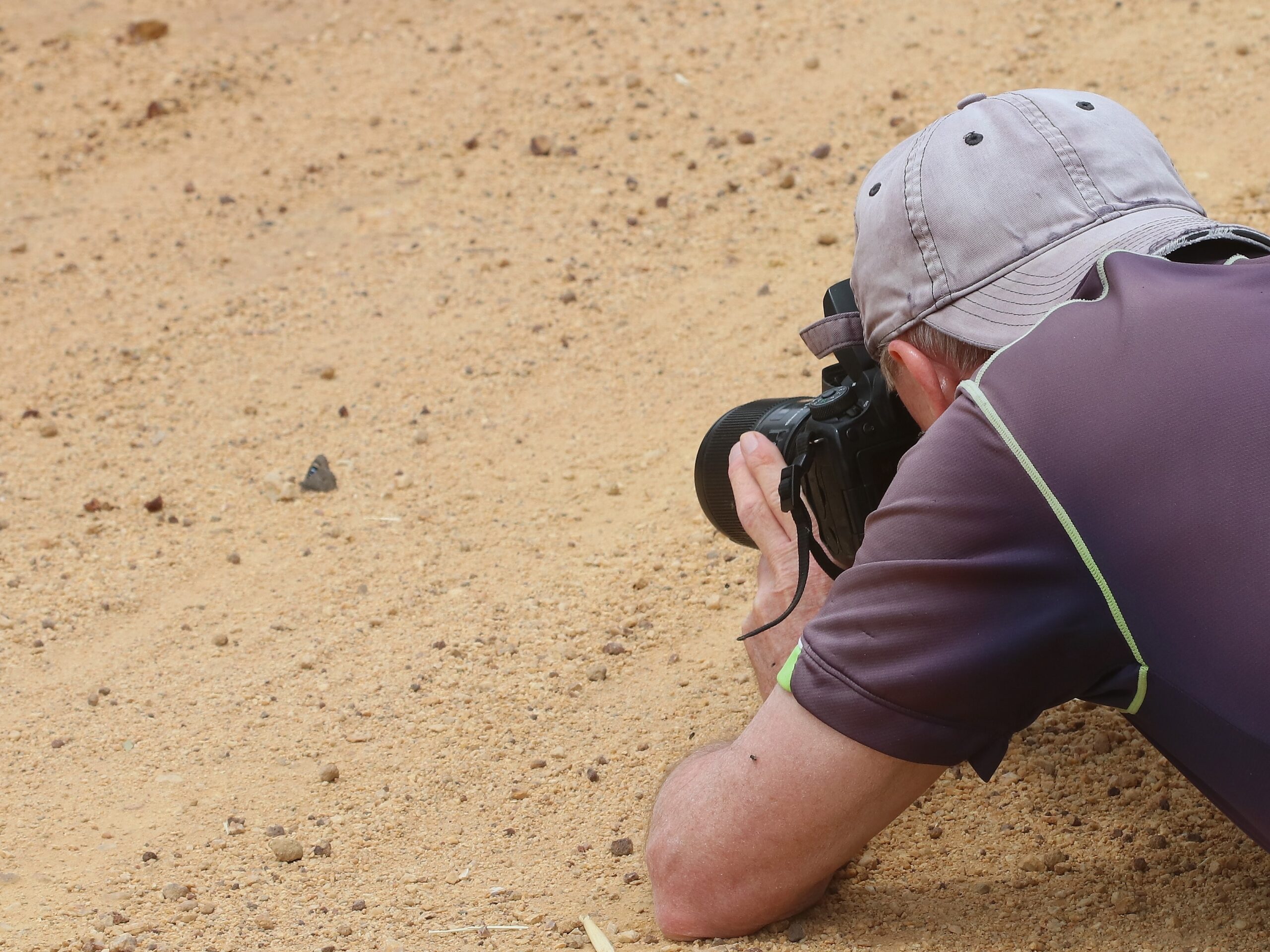
Derek’s photo of me photographing Dennis
Females were harder to find; presumably they do show up along the road at times, otherwise it would be pointless for the males to defend territories there, but we didn’t see any. We went looking for them in the bush off to the side of the road. It took quite a while to find any, but eventually we were able to get some photos. I had only photographed males in 2016, so whilst I’m not totally happy with the photos of females I took this time I’m still happy I got them.
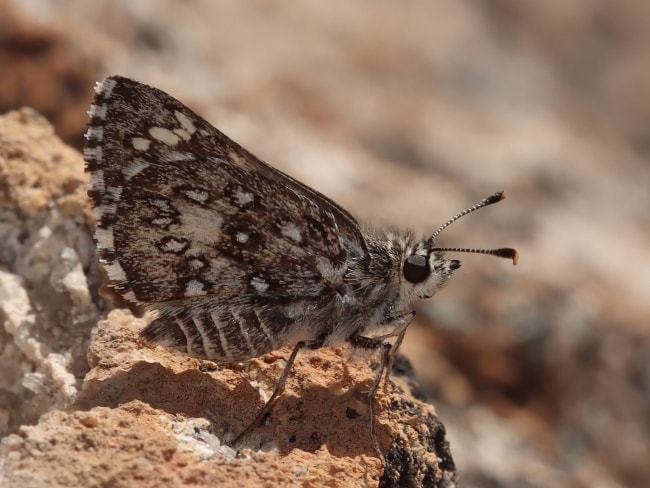
In the afternoon we continued driving in the direction of Southern Cross, stopping off at some laterite mounds close to the road to look for the waterhousei. We hadn’t even reached the mound before Ross spotted the first one, and on top there were plenty of them. Whilst they look very attractive in photos, when these skippers are settled on the rocks they’re almost impossible to see as they’re superbly camouflaged. I had been very keen to see this species again, but in the 9 years that had passed since I last saw them I had forgotten just what a pain they can be to photograph. They mostly settle on the ground, which on the top of the mounds consists of hard and sharp rock, which results in a fair bit of skin being lost from knees and elbows as I get into position to take photos. Typically they then fly off before I get the shot.
I did eventually get some fairly decent photos, though I’d have to say that I have never quite really nailed a waterhousei shot. Oh well, at least I tried.
That evening Ross discovered that he’d picked up a tick during the day.
Monday 27th October
After a productive day on Sunday, the Monday brought us back down to earth. We left Southern Cross early and headed to a location in the Kalgoorlie area in the hope of finding the Inland Hairstreak (Jalmenus aridus). After several hours of fruitless searching we found out that we were about a week too late and the aridus were no longer on the wing.
We therefore went and spent the rest of the day on a hill near Kambalda in the hope of seeing some interesting hilltoppers. There were a number of Spotted Jezebels (Delias aganippe), more than I’ve ever seen in one place, and a couple of colourful male Varied Dusky-blues (Erina hyacinthina simplex) – so much prettier than the subspecies I’m used to seeing back around Sydney. They were the only things I photographed that day, apart from one or two fresh specimens of Wattle Blue (Theclinesthes miskini).
The highlight of the day was having dinner that evening with Rod Eastwood, plus of course Ross’ inevitable discovery of a tick on his leg.
Tuesday 28th October : back to Southern Cross
We made another early start so we could go back to the waterhousei site in the morning. It was a warmer and sunnier day than on Sunday, making the skippers friskier and even less cooperative than before.
We took a break for lunch, during which Derek suggested that in the afternoon we should take a look at a reserve near Bodallin rather than go chasing waterhousei again. When we got there we all thought that the reserve looked very promising, though it was quite some time before we saw much. Eventually I disturbed an Ogyris, and later on Derek photographed males and a female and I got a shot of a male. We all had different opinions as to what they were; I went for Ogyris arcana sublustris, Ross for O. arcana arcana and Derek’s guess was O. idmo. In the evening Ross sent the photos to Rod Eastwood, who confirmed that Derek was correct and these butterflies were idmo, albeit small specimens.
A highlight for me came late in the afternoon, when Derek and I were hanging around some flowers where Derek had photographed his female idmo. One of the flowering bushes was right underneath a tree that was host to several mistletoes; right in front of my eyes a Silky Azure (Ogyris oroetes) flew about and settled in the lowest of the mistletoes, below waist height. I wasn’t able to get a shot, though a bit later on Derek got a couple of long-distance images of it perched on a dead branch high up, his first shots of oroetes.
That evening Ross found another tick, after which we went for dinner at one of the pubs in town. Or at least we tried to. The place wasn’t particularly busy, but when we tried to order our meals we were told that they’d stopped serving food because the cook had just gone home as she was overwhelmed. We went to the other pub instead, and for the rest of the fortnight the word “overwhelmed” became something of a catch phrase.
Wednesday 29th October : return to Perth
We decided to stop in at Bodallin again, in the hope of seeing more Ogyris. I was especially keen to get the oroetes as it would be a new species for me, and expecting it to mostly settle high up I began the day with my 300mm lens on the camera, instead of my usual Sigma 150mm macro.
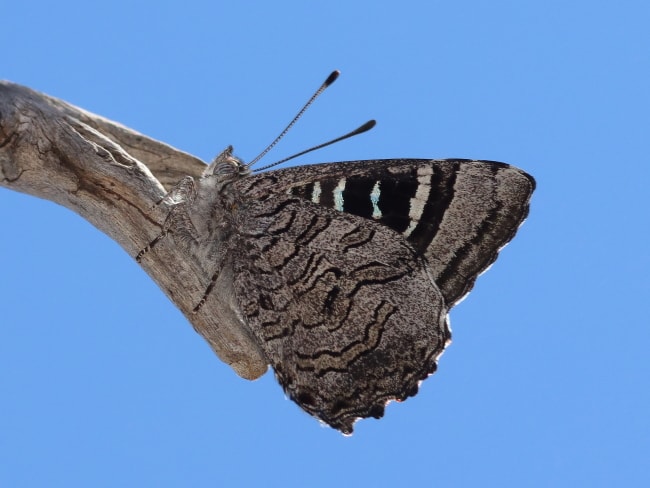
I was pleasantly surprised to spot the oroetes almost immediately, and before 8:30am I had been able to get some shots of him fairly high up. he turned out to be rather well-behaved for an Ogyris, as he’d fly around for a short time and then settle, allowing Derek and I to get different shots of him, at times taking it in turns to use the 300mm lens. Best of all he finally deigned to settle much lower down so we could get close-up shots; low enough in fact that I would have preferred to use the macro lens, though I didn’t want to risk missing the shot by changing lenses.
As usual before a butterflying trip I had made a list of the species I particularly hoped to get, however unrealistic that list might be, and for this trip I hadn’t even put oroetes on the list as I didn’t think I’d have a chance of getting it. Ironically it became my first new species for this trip, as well as being a new species for Derek and a new subspecies for Ross.
Our next stop was at another reserve where we’d been told we might see the Amethyst Hairstreak (Jalmenus icilius). There were none on the wing, but this time we were a couple of weeks too early for them. Ross found a couple of pupae and prepupae, and I had a couple of sightings of an Ogyris – probably idmo – but there was nothing much else to be seen.
Our last stop before getting back to Perth was at Quairading. Derek and I had been there in 2016 and 2017 looking for the Narrow-winged Iris Skipper (Mesodina hayi), which was first described from that site. We didn’t find it, but in 2016 we did photograph Pale Sand-skippers (Croitana croites) which was a first for both of us. In 2017 we hardly saw any butterflies at all, though we did find a huge amount of spear grass, to the point where we both just threw our socks into the garbage bin at the end of the day.
This third visit was also fruitless; we saw virtually no butterflies, though there were a few rather nice sun moths. And Ross picked up a tick.
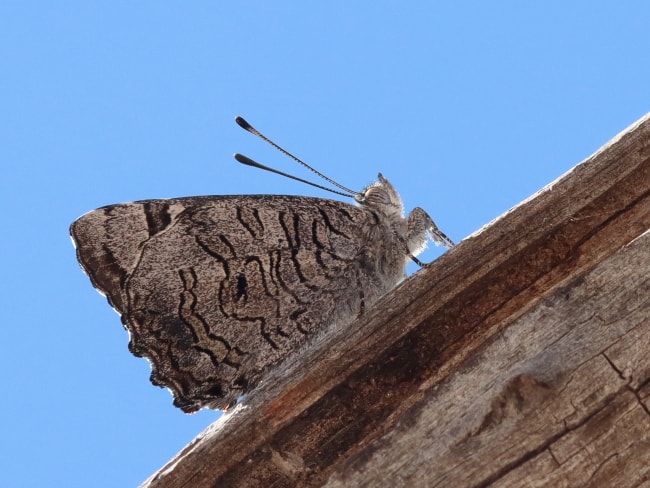
Thursday 30th April : Watheroo and Leeman
After spending the night at Derek’s place in Perth, we set out on the northern leg of our jaunt around WA, for which we would mostly be based at Jurien Bay. Our first port of call was in the Watheroo National Park, where we met up with rangers Betty and Lauren but totally failed to find any sign of our first target for the day, Jalmenus icilius. This was the fourth time on this WA trip we’d looked for Jalmenus without seeing a single one on the wing; we also didn’t see any Fiery Jewels (Hypochrysopa ignitus oliffi) which we’d been told we had a good chance of finding at Watheroo. The weather was against us here; despite the decent forecast it was overcast almost the entire time.
Heading back to the coast we went to Leeman to look for Western Bronze Azures (Ogyris arcana sublustris), which Ross in particular was keen to get. In previous visits here Derek and I have mostly seen these butterflies nectaring from flowers of Chenille Honeymyrtle (Melaeuca huegelli), but this time virtually none of those flowers were yet open. Perhaps because of this we only saw one or two of the Ogyris, though in the sand dunes we did find the occasional Western Jewel (Hypochrysops halyaetus) and Silver-spotted Ochre (Trapezites argenteoornatus), though I wasn’t able to get any shots of the latter.
All in all this was a very unproductive day, though Ross got another tick.
Friday 31st October : Dongara
Less driving today, as Dongara is about 80 minutes’ drive north of where we were staying at Jurien Bay. For some reason the GPS tried to tell us that the road was closed just north of Leeman so we’d have to take a diversion inland which would add a fair bit of travel time. This turned out to be completely untrue, but the GPS continued to stick to this story every time we went along this road over the next few days.
Derek and I had had some success at Dongara in 2016 and 2017, notably getting our first Ogyris idmo shots there, so we were hopeful of a decent day’s butterflying. Shortly after arriving I spotted a female idmo flying close to the ground, though I didn’t get a chance of a photo, and during the day we also had sightings of O. arcana sublustris and Satin Azures (O. amaryllis), though I wasn’t able to get shots of any of them. The closest I came was late in the afternoon, when a male sublustris flew across and settled at the edge of the path only a few inches away from my left foot. Because he was so close the angle wouldn’t have made a decent photo, and he flew away before I could think of how to get to a better position.
For me the highlight of the day was seeing a lot of Western Jewels (Hypochrysops halyaetus), the most I’ve seen since the amazing days at Koondoola in 2008 when they were absolutely everywhere. They’re extremely pretty butterflies, and despite their small size they were able to hold their own when dogfighting with the much larger Ogyris.
That evening, to nobody’s great surprise, Ross found a tick.
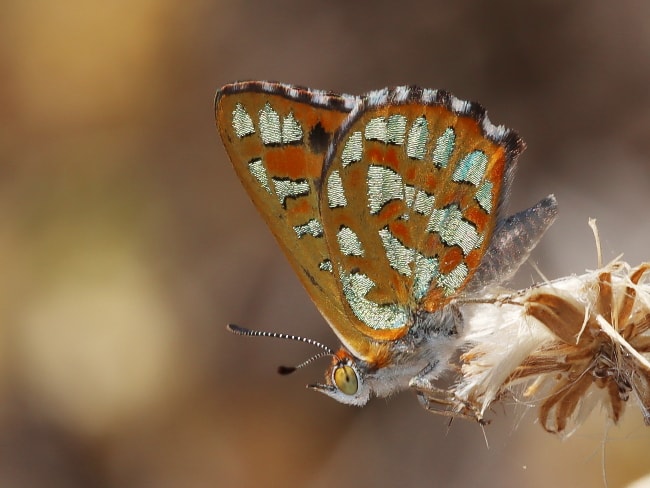
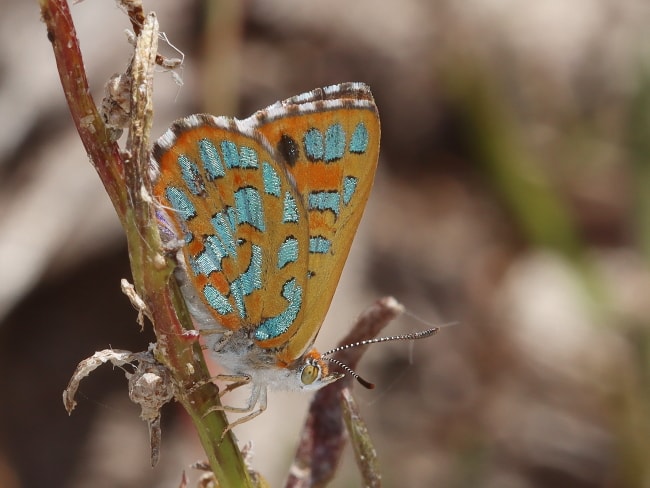
Saturday 1st November : Kalbarri
This was another day with a big target; we drove to Kalbarri in search of Narrow-winged Iris-skippers (Mesodina hayi). We left Jurien Bay early and, ignoring the GPS’s lies about the road closure we took the North West Coastal Highway to the north, passing through the little town of Northampton, namesake of my English birthplace. This Northampton has a population of under 1000, but probably has at least as much nightlife as the other Northampton.
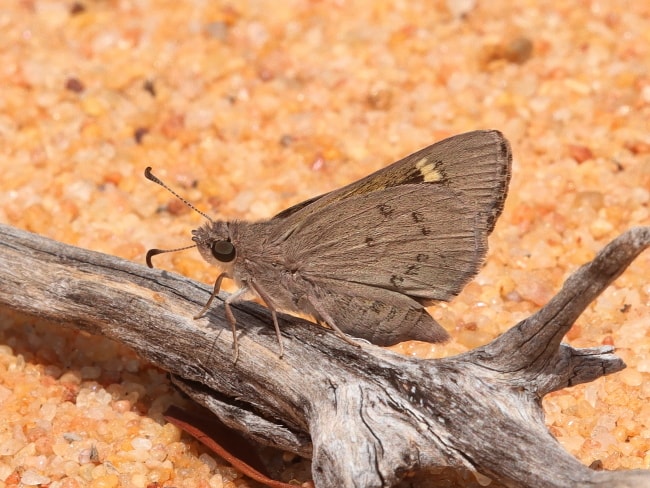
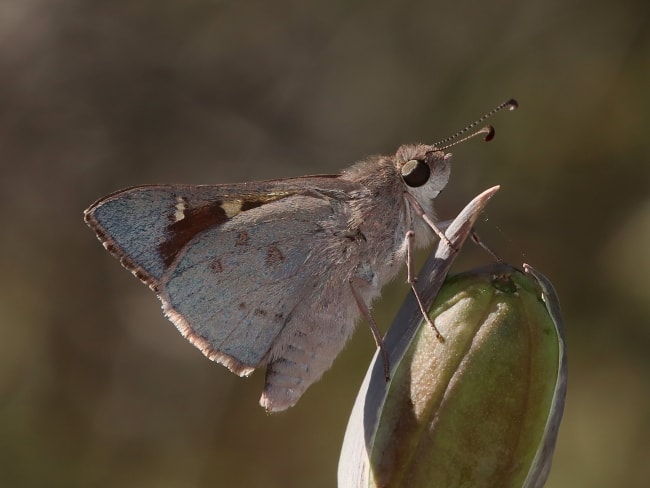
As we approached the required distance north of the Murchisson River we stopped to look for hayi, but found absolutely no butterflies at all, and none of hayi‘s Pattersonia foodplants. This happened two or three times, until we began seeing Pattersonia growing right next to the road. We again started searching the areas near those plants, though initially we were looking at the wrong species. Fortunately Derek correctly identified the smaller Pattersonia drummondi which was very common there in sandy areas between the trees. We split up to look for the skippers, and after about 30 minutes I spotted a small, dark skipper scooting rapidly between the clumps of drummondi. It didn’t settle, and over the next quarter of an hour I had several similar sightings without getting any chance of a photo.
Derek then appeared and told me he’d had exactly the same experience. We hung around the area for a while, and were rewarded with a fresh female hayi who plonked herself down on a fallen branch and just sat there. In what was one of my favourite moment of the whole fortnight, Derek and I both photographed our first hayi together; the same butterfly at the same time. This was my second new species for the trip.
Ross had also been having some luck, and had found a spot that the skippers just kept on coming back to. By now it was warmer and the behaviour of the hayi had changed; whereas previously they mostly just kept flying close to the ground, now they were settling much more often, and for longer periods. This made it harder to initially spot them, but it did mean that if you found one there was a much better chance of getting photos. I stayed around there for a while and took a number of shots, all of males, before heading back to where I’d seen that first female. This time that area was home to a very fresh male, who was very cooperative and gave me the chance to take shots of his underside and upperside, though I made a bit of a mess of the latter and didn’t get really sharp photos.
After about 2pm we pretty much stopped seeing any hayi, and seeing as we reckoned we’d done pretty well we decided to head towards the town of Kalbarri, where Derek had booked our accommodation for the night. We did very briefly have a look at another hayi location on the way, but we didn’t see anything there.
We’d been warned that the area where we’d found our hayi was bad for ticks, but it didn’t turn out that way and we didn’t get any. Except for Ross; he got one.
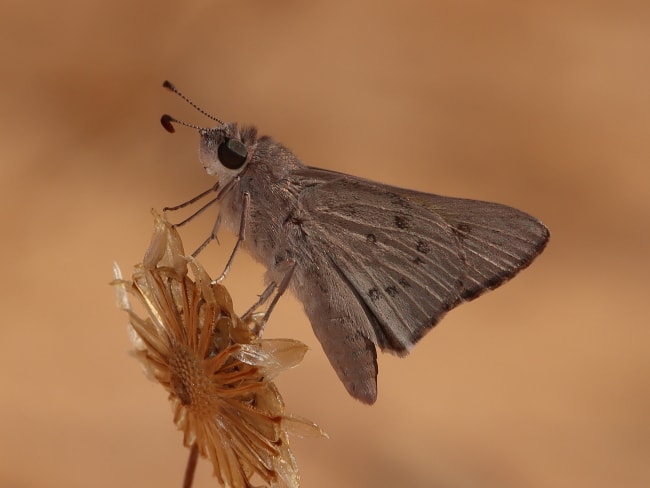
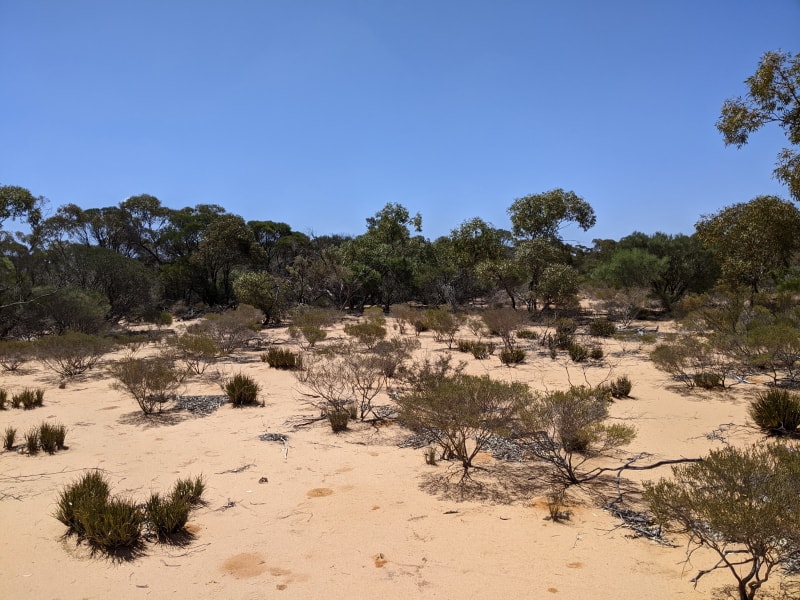
Mesodina hayi habitat at Kalbarri National Park
Sunday 2nd November : back to Perth (again)
This was a big driving day as we had to get all the way back to Perth, but we did manage to do some butterflying on the way. Most notable of these stops was at Molah Hill near Jurien Bay, which had a lovely view of the coast and was also a good site for some hilltopping butterflies. We saw several more H. halyaetus here, always a welcome sight and mostly beautiful specimens too, as well as some beautiful Varied Dusky-blues (Erina hyacinthina simplex) which were every bit as flashy in flight as the Jewels.
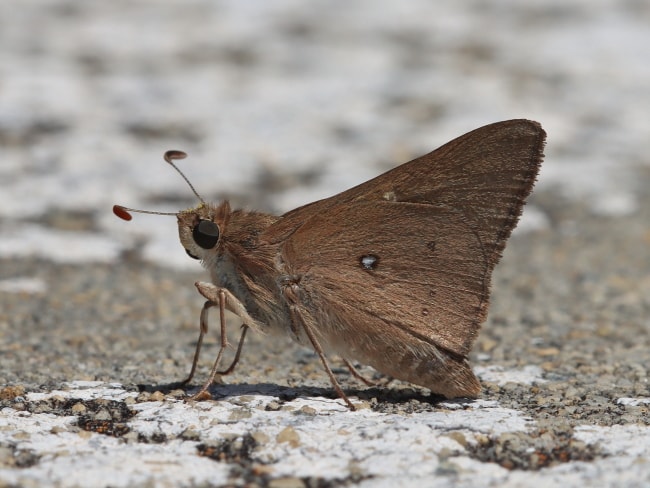
At the very top of the hill we saw our only Western Brown Skippers (Hesperilla dirphia) of the fortnight. As it was quite hot they only settled with their wings closed, which was a shame as they were males and I’d have liked to get shots of their unusual sex brand. In the end I only got a couple of photos, the best of which was of a dirphia sitting on the concrete floor; not the most attractive setting for the picture.
Next stop was Lake Thetis, near Cervantes, where Derek and Ross had found Hesperilla donnysa galena 3 years previously, though this isn’t certain as it might fall into the range of H. d. albina instead. I didn’t have shots of either of the WA subspecies of donnysa so I was keen to have a look, but although we found lots of their Gahnia foodplant there were no skippers there. Ross and I did have a quick glimpse of a skipper near the carpark, but we didn’t get a decent look at it.
For our final stop I made the mistake of suggesting that we try Nambung National Park to look for Ogyris amaryllis and O. arcana sublustris amongst the dunes. Tobias had got lovely close-ups of both species there, though Derek and I hadn’t seen them when we tried the spot in 2017. And so we three butterflyers found ourselves walking miles down a long, empty beach whilst being sandblasted by a force 10 gale, only to find no butterflies when we got there.
We finally made it back to Perth, carrying with us the vanilla slice from a Jurien Bay bakery without which Derek’s wife Fran wouldn’t have let us into the house.
And yes, Ross the Tick Magnet managed to keep his 100% record intact by finding one that evening.
Monday 3rd November : Perth
With Derek being unavailable today, Ross and I decided to revisit Lesmurdie and Koondoola in the hope that the better weather would bring us more luck. It was windy and chilly when we got out of the car at Lesmurdie and it took a while for it to warm up enough for the dactyliota to start flying, but fly they did and there were decent numbers of them on the wing.
Curiously at first all we saw were males, then it went quiet for a while before we started seeing females, without any males. Later on the males took over again. Neither of us had an explanation for this, other than perhaps that the butterflies were deliberately screwing with our minds. I finally managed to get my first dactyliota shots since 2008, and happily I was able to get upperside and underside shots of both males and females. I still don’t think I’ve ever managed to do this species justice; fresh specimens are very attractive indeed, but most of my shots show slightly older specimens that don’t quite have that pristine look.
Before leaving the house in the morning, anticipating the afternoon at Koondoola, I had applied vast amounts of Bushman lotion to my entire body in the hope that it would keep the ticks off, though with the benefit of hindsight I probably needn’t have bothered, as they’d have all gone after Ross anyway. Upon arrival at Koondoola I also sprayed my legs and boots with Aerogard, so much so that a hole immediately opened in the ozone layer directly overhead. Ross also used some, though you can probably guess the outcome of that…
We were expecting Koondoola to be a lot busier than last time, but once again it was rather devoid of butterflies. There were large areas full of Pattersonia irises, and eventually we started finding Blue Iris-skippers (Mesodina cyanophracta). We ended up seeing a decent number of them, though not nearly as many as might be expected given the amount of their foodplant that was growing there. I wouldn’t be surprised if every now and then these skippers have one a bumper year when they’re all over the place at Koondoola, but this wasn’t one of those years.
We had several periods where we didn’t see any cyanophracta, at one point Ross called out “I haven’t seen one for ages”, though he almost immediately followed with “Wait, there’s one!”. This actually happened 3 or 4 times; it became something of a running joke between us that if it went quiet Ross had to say the Magic Words.
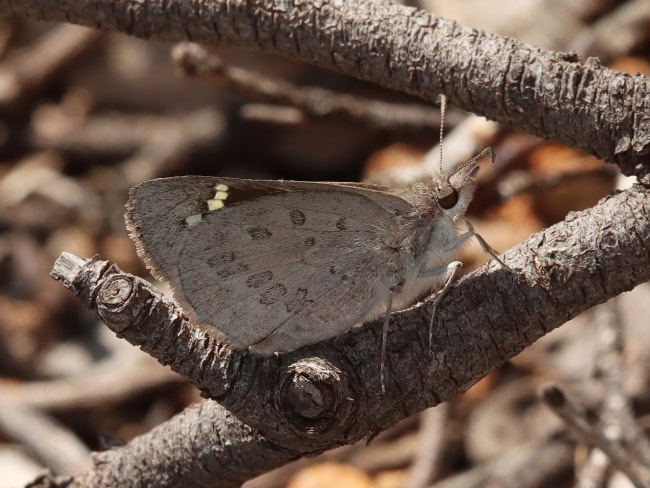
The last butterfly I photographed that day was particularly well-behaved. He settled on a sturdy perch, which prevented the wind from blowing him about, and simply sat there while I snapped away with my camera. The name “cyanophracta” refers to the blue tinge that can be seen on this species’ grey undersides, though I’d never really seen it myself. I did see it that day, particularly in that last specimen.
Ross and I then spent a bit of time looking for Hypochrysops halyaetus, but again we didn’t see a single one. It seems curious that Koondoola can be such a great site for them in some years, but at other times it can be difficult to see them at all. We did see some Western Grey kangaroos just chilling out not far from the path; it must be a rather inbred population as that biushland is completely surrounded by suburbia.
Back at Derek’s house I was pleased to see that covering myself in a cocktail of lethal toxic chemicals had deterred the ticks. Ross had one.
Tuesday 4th November : south to Bunbury
The third and final leg of the fortnight was to go South from Perth, spending 4 or 5 days butterflying in places like Windy Harbour and the Stirling Range National Park. At least that was the plan…
First stop was Port Kennedy, where I’d had such a productive day on my first visit in 2008, though I hadn’t seen much there since. We were hoping to see the Western Bitter-bush Blue (Theclinesthes hesperia) and Varied Hairstreaks (Jalmenus inous), though it was overcast and fairly windy and we hardly saw anything at all. This made it the 5th time we’d struck out when hoping to see Jalmenus on the wing.
We then paid a quick visit to a site of Derek’s at Rockingham, slightly further south, where Derek and Ross had seen inous and Hesperilla donnysa albina 3 years ago. They’d been hampered by poor weather then, and it was lousy this time too, with rain starting to fall shortly after we left the car. Ross did at least see one inous – I didn’t – but our day had not started well.
Next was perhaps the most exciting target of the day, to me at least, as we went inland to Hoffman Mill to look for the Western Dusky-blue (Erina gilesi). We’d been given GPS coordinates to a spot where they were supposed to be common; the road was closed a few kilometres short of the spot so we had to walk the rest of the way. When we go there we found absolutely nothing. There was none of gilesi‘s Cassytha foodplant around and no butterflies at all. Ironically the weather had brightened quite a bit, so that if butterflies had been there we’d have seen them, there simply weren’t any to be seen. I don’t know whether the GPS coordinates were incorrect, or if the site had changed since gilesi had been recorded from that location – the paper in question did state that it was extensively burned by bushfires in January 2016.
There was some Cassytha along a creek not too far from the GPS location; I got down alongside the creek but I found the going difficult due to getting entangled with blackberry plants, though that didn’t worry me quite as much as the thought of getting entangled with the Tiger snakes that tend to frequent that sort of habitat.
We gave up, walked back to the car and headed for Bunbury. We were to stay the night in a cottage there, but we still had time to go to Maiden’s Reserve to look for Yellow Sand-skippers (Croitana flavescens). We didn’t see any; the weather was fairly miserable again, though still preferable to the decor of the cottage in which we stayed the night.
We didn’t get any butterflies that day, though Ross got a tick and unfortunately Derek was now getting rather sick. I’d had a cold for the past few days, presumably caught from someone on the flight from Sydney, but it hadn’t been too bad apart from the day I broke the World Snot record. Unfortunately I’d passed it onto Derek.
Wednesday 5th November : bleah!
Today we’d planned to drive down to Windy Harbour, which despite its rather discouraging name was supposed to be a good site for several species. We did get there and it was fairly windy, but it was also raining most of the time which was a shame because it looked like a very interesting place. What’s more it really looked like somewhere that ought to be good for butterflies. Just not today, and according to the weather forecast not for the next week or so. In fact the whole south-west corner of WA looked like it was going to be wet for the remainder of our butterfly fortnight, which was not at all what we wanted to hear.
We thought we might as well go and have a look at a spot near Crystal Springs, where Derek and Ross had seen loads of Golden-haired Sedge-skippers (Hesperilla chrysotricha) 3 years ago, as well as some Ogyris idmo. I was eager to see chrysotricha; I love my skippers and that’s a particularly fine species, but I’d never seen one. So we went to the site, expecting the the worst, and we got it. It was still raining and the ‘road’ we had to drive along was about as trustworthy as the financial records of FTX Cryptocurrency exchange. This road was named Railway Parade, and the lack of any railway in the vicinity was the least of its worries. At times it felt like the car was going to disappear forever in one of the holes, so Ross had no choice but to give up and turn back. If the weather had been decent we’d have just parked and walked up to where the guys had seen the chrysotricha, but there was no point on this day.
Closer to Mount Barker things looked slightly brighter, so we went out to Pongurup to see if we could find any of the WA version of the Common Brown (Heteronympha merope doubledayi). The clouds thickened when we got there, and we didn’t see anything. So for the second day in a row we didn’t get any butterflies.
We gave up and went to our accommodation in Mount Barker. This had been described as a ‘cosy cottage’, which had us all worried as that was also the term used to describe the house of horrors at Bunbury, but in fact this one was really nice, which was just as well as we were due to stay there for 3 nights.
When Ross went for his shower we could hear him call out “Another one!”. This time he’d found two ticks, not bad going considering we’d hardly left the car all day.
Thursday 6th November : back to Perth (for the last time)
In the morning we found a) that Derek was feeling really bad and b) the weather forecast for the next few days was disgusting, though the Perth area was looking much better. Before long we decided to give up on the Stirling Range etc and go back to Perth.
Our route took us right past Boscabel, a site where Derek and Ross had previously seen a number of Ogyris idmo. Ross and I decided that though it was mainly overcast it was much better here than at Mount Barker, so we might as well have a look for idmo. Derek stayed in the car to rest. For the best part of an hour we didn’t see anything, but once Ross spotted the first one we began to have quite regular sightings of them. The first one I managed to photograph was a male – a lovely specimen too – who flew during a brief sunny interlude but then settled the moment the sun went in. He was perched on the end of a dead tree stump and I lucky enough to get a very nice shot of him.
After several failed attempts at other idmo – they can be hard to follow in flight and tricky to approach – I found another male who didn’t fly much, though in this case it was because he’d lost much of his left hind wing. After photographing that side I worked round to his intact side, which was more photogenic, after which he flew up to feed from a grass-tree flower.
The highlight of this day was a perfect female idmo who I spotted in flight; to my surprise after slowly circling the area a couple of times she landed on the ground just a few feet in front of me, in an ideal position for photos. Every other female idmo I saw settle that day – maybe 4 or 5 others – landed close to a shrub and then walked forwards to be partially beneath it, but this one just stayed put in the open. I gratefully took my photos of her; she was a stunning insect.
We got back to Perth at around 4pm; Derek soon went to bed whilst Ross went to find his Tick Of The Day.
Friday 7th November : Rockingham
With Derek out of action Ross and I decided to go back to Rockingham. After seeing the enormous tick that Ross found sitting on his butterfly net on our brief visit a few days earlier, I once again covered myself with an inch-thick layer of Bushman lotion. I figured that even if the DEET didn’t put them off it would still take them a while to burrow through the stuff to reach me.
We got to Rockingham early so it was still a little cool, but we’d only been there a few minutes before we started seeing Jalmenus inous; on the penultimate day of the WA trip I finally got to see a Jalmenus. I hadn’t seen inous since 2017, and I’d forgotten just how dark they look in flight compared to other Jalmenus species I’ve seen.
Whilst it was great to see inous, the butterfly I really wanted to see here was WA’s southern subspecies of the Varied Sedge-skipper (Hesperilla donnysa albina), as this would be a new subspecies for me. I’d hoped to get the more northerly subspecies galena on the way to or from Kalbarri but it didn’t happen. After about an hour I began to catch glimpses of donnysa flying amongst the Gahnia plants, but I wasn’t able to get close enough for a photo until a male briefly settled on a flower to bask in the sunshine. Next I photographed a large female, who settled right in front of me to wait out a short cloudy interval.
Ross and I spent a few hours with the donnysa. There were quite a large number of them, though there was a ridiculous amount of the Gahnia at this location which; there have been enough to support a very large population of the skippers.
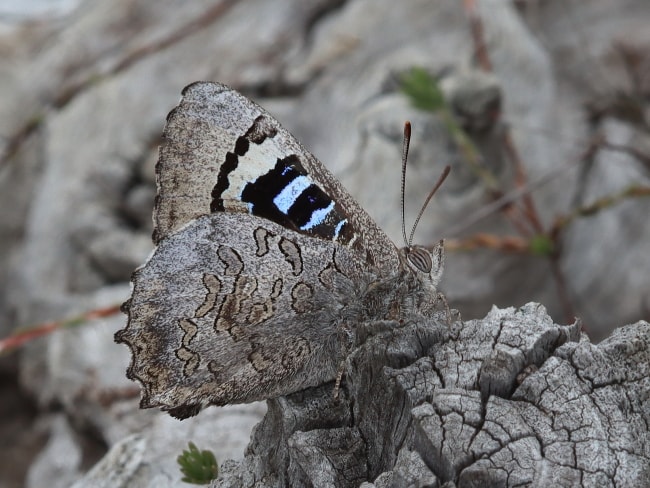
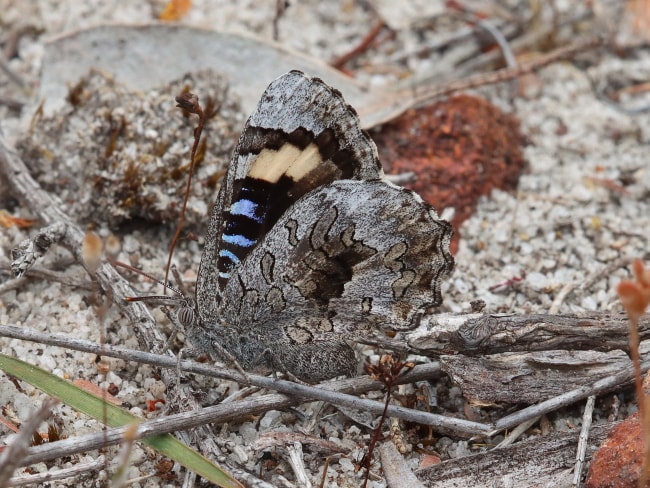
After a break for lunch we had a look around another area of the bushland; we found more inous and a few more donnysa, as well as plenty of Western Xenicas (Geitoneura minyas), though most of these were a bit old and faded.
A new subspecies – got to be happy with that. And once again I’d managed to avoid being bitten by any ticks, though it had been a close thing. After photographing that first female donnysa I stood up to check the shots on my camera screen but noticed a huge tick sitting on my trouser leg. Ticks are ugly things at the best of times, but this thing was enormous and completely revolting. I tried to flick it off my leg, but it just clung on; I thought it snarled at me but that was probably just my imagination. It took me several attempts to get rid of the thing. Fortunately I didn’t find any when I checked myself back at the house; Ross was unlucky again.
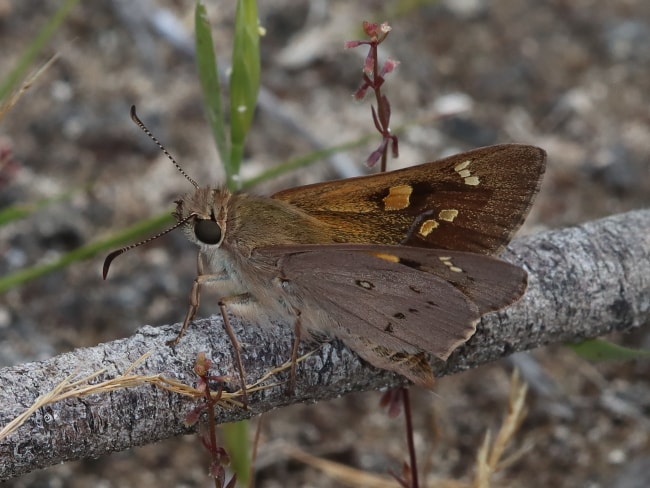
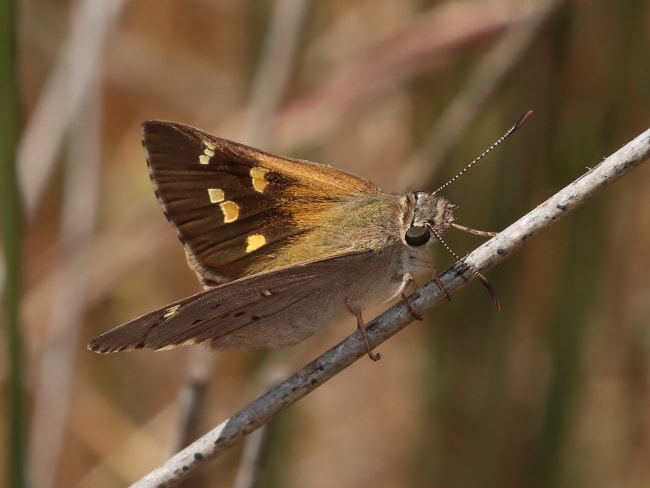
Saturday 8th November : Lake Preston
For the last day Ross and I chose to have another go at finding Erina gilesi, so we went to a known location for it alongside Lake Preston near Myalup. We had GPS coordinates for it, and as soon as we reached the spot we could see the Cassytha growing amongst the trees at the roadside. At this spot there was only a thin stand of trees after which an open space led to the lake itself.
We got out of the car to check it out. There was nothing on the wing, and it occurred to me that as this side was mostly in the shade I might have more chance if I could get through to the other side of the stand of trees. I soon found a little track which led through some Gahnia plants to the far side of the trees. I couldn’t see anything flying around the Gahnia, but before long I saw a large skipper flying very rapidly around the open area before settling on a thistle flower. As I got closer I could see that without doubt this was a Golden-haired Sedge-skipper (Hesperilla chrysotricha), a butterfly I’d never seen before but which had been second on my Want List for the whole trip (after Jalmenus aridus).
I took a few photos of this skipper, but at the time the wind was quite strong and the thistle was being blown around quite a bit, so the photos aren’t much good and I didn’t end up using them (though I would have had I not got better shots a bit later on). Whilst I was praying for the wind to stop Ross called my phone to let me know that he was next to a patch of flowers near the car and had just seen a chrysotricha too. I told him about my one, and the way through the trees, and before long he joined me. My first decent shot of a chrysotricha came after Ross called me over to a patch of Gahnia; shortly afterwards I went over to check out that patch of flowers Ross had told me about. I photographed another male chrysotricha there, along with a female H. donnysa albina, and I had a fun moment when I almost stepped on a brown snake that I hadn’t spotted basking next to the flowers.
Shortly after that Ross called me again, saying I should get over where he was, which turned out to be almost out at the very edge of the lake. He’d gone to check out another patch of Gahnia close to the lake and found several chrysotricha feeding on some white flowers nearby. We spent the next hour or two around there, enjoying the sight of these lovely skippers; the females in particular were very colourful. There were one or two of the donnysa as well; nice to see them again.
After a lunch break we decided to try again for gilesi. Ross wanted to look around the Cassytha amongst the trees near the lake, while I opted to go along a track up through the dunes in the hopes of finding them on a high point somewhere, as I’d read that the males are strong hilltoppers. Neither of us saw any sign of gilesi at all. Apparently we were about a month early for them as they’re on the wing in late November and December in that area. We didn’t get any butterflies at all that afternoon, but it was still a successful day and I had my 3rd new species for the trip.
In the evening Ross confirmed that he had managed to pick up a tick every day of the fortnight. I’d only had one that actually bit me; there was that one on my trouser leg at Rockingham and I’d also had one walking on my leg at Dongara. On 3 or 4 occasions I’d found very small ticks on me whilst in the car, either on my arm or trousers, though each of these times they were just trying to find their way over to Ross.
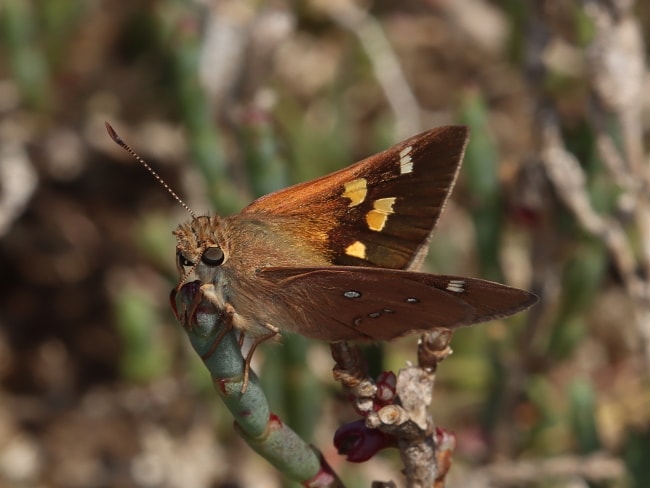
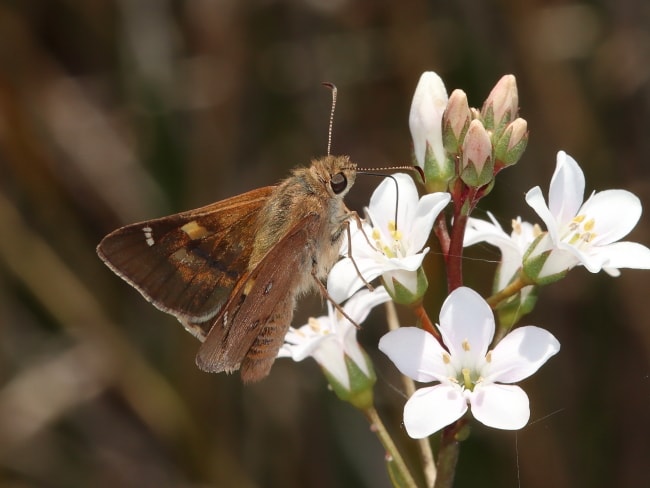
Sunday 9th November : back home
Ross and I both had morning flights from Perth airport. I was back home by 6pm; Ross was later as he had to change flights in Melbourne. After he got back home Ross called me and mentioned that he’d found another tick!
Photo Gallery Updates
New species : Ogyris oroetes (Silky Azure)
New species : Mesodina hayi (Narrow-winged Iris-skipper)
New species : Hesperilla chrysotricha (Golden-haired Sedge-skipper)
New subspecies : Hesperilla donnysa albina
I’ve also added photos to the following species pages:
Elodina angulipennis (Southern Pearl-white)
Delias aganippe (Spotted Jezebel)
Delias nigrina (Common Jezebel)
Euploea corinna (Common Crow)
Geitoneura minyas (Western Xenica)
Paralucia spinifera (Purple Copper)
Hypochrysops halyaetus (Western Jewel)
Ogyris idmo (Large Bronze Azure)
Ogyris petrina (Arid Bronze Azure)
Jalmenus inous (Varied Hairstreak)
Deudorix diovis (Bright Cornelian)
Erina hyacinthina simplex (Varied Dusky-blue)
Eirmocides consimilis (Dark Pencil-blue)
Cyprotides cyprotus (Copper Pencil-blue)
Nacaduba biocellata (Two-spotted Line-blue)
Prosotas felderi (Short-tailed Line-blue)
Neolucia mathewi (Dull Heath-blue)
Theclinesthes miskini (Wattle Blue)
Trapezites sciron sciron (Sciron Ochre)
Trapezites argenteoornatus (Silver-spotted Ochre)
Trapezites waterhousei (Laterite Ochre)
Hesperilla dirphia (Western Brown Skipper)
Antipodia dactyliota (Western Sand-skipper)
Mesodina halyzia (Eastern Iris-skipper)
Mesodina cyanophracta (Blue Iris-skipper)
Ocybadistes walkeri (Green Grass-dart)
Contacts page
Whilst working on the November 2023 update I tested out my Contacts page and found that my email form is no longer working. I don’t know why it broke or when it happened, so if you’ve tried contacting me that way and received no reply, please accept my apologies.
I had a go at fixing it but didn’t get it working. In the meantime I’ve replaced the form with links to my Facebook and Instagram, as it should be possible to contact me that way instead.
A very successful trip Martin with some great photos, really like the Hesperilla chrysotricha, a beautiful insect.
Thanks Al. It was great to finally get chrysotricha!
G’day Martin, my name is Kim and Im from Mackay Regional Botanic Gardens. I am trying to get in contact with you regarding use of one of your images of an adult Sabera dobboe, Yellow-streaked Swift. I am updating a butterfly host plant brochure and want to feature Sabera dobboe and Cordyline manners-suttoniae but unable to find a decent image. You have assisted me previously with the use of Paragraphium leosenthes leosenthes. Im just wondering if you would be ok if I am able to use one of your images again and credit your image in our brochure. Thanks so much I have provided my contact below.
Kim Blythe – kimberley.blythe@mackay.qld.gov.au
What an awesome trip! Some absolutely stunning photos of some elusive Western Australian species, in particular Dennis and M.hayi :). Really loving these posts.